Research into Music Use in Branded Social Content
Trakr analysed 200,000+ TikTok posts from 800 brands over 18 months. 79% were using music with no clear evidence of licensing.
The Research That Led to Trakr
Before we built anything, we needed to know whether the problem was real.
Between July 2024 and January 2026, we analysed every musical recording used on TikTok by 800 commercial brands, covering 200,000+ posts across 18 months. Every track was identified and mapped back to its rights holders.
The 800 brands in our dataset represent less than 1% of the brands actively using TikTok and social media for commercial purposes. What we found in that 1% was enough to answer the question.
The Research That Led to Trakr
Before we built anything, we needed to know whether the problem was real.
Between July 2024 and January 2026, we analysed every musical recording used on TikTok by 800 commercial brands, covering 200,000+ posts across 18 months. Every track was identified and mapped back to its rights holders.
The 800 brands in our dataset represent less than 1% of the brands actively using TikTok and social media for commercial purposes. What we found in that 1% was enough to answer the question.
Key Findings
200,000+
Total posts analysed
800 Brands
less than 1% of the global market
79%
Brands with no clear licensing evidence
16,000+
Posts with no clear evidence of commercial music licensing
4,100+
Unique titles from major and significant independents
1.14B+
Views generated by likely unlicensed posts
60M+
Likes generated without commercial licensing
4M+
Shares generated without commercial licensing
1.13M+
Comments generated without commercial licensing
Key Findings
200,000+
Total posts analysed
800 Brands
less than 1% of the global market
79%
Brands with no clear licensing evidence
16,000+
Posts with no clear evidence of commercial music licensing
4,100+
Unique titles from major and significant independents
1.14B+
Views generated by likely unlicensed posts
60M+
Likes generated without commercial licensing
4M+
Shares generated without commercial licensing
1.13M+
Comments generated without commercial licensing
Value Generated. Nothing Paid.
The engagement figures above translate directly into commercial value.
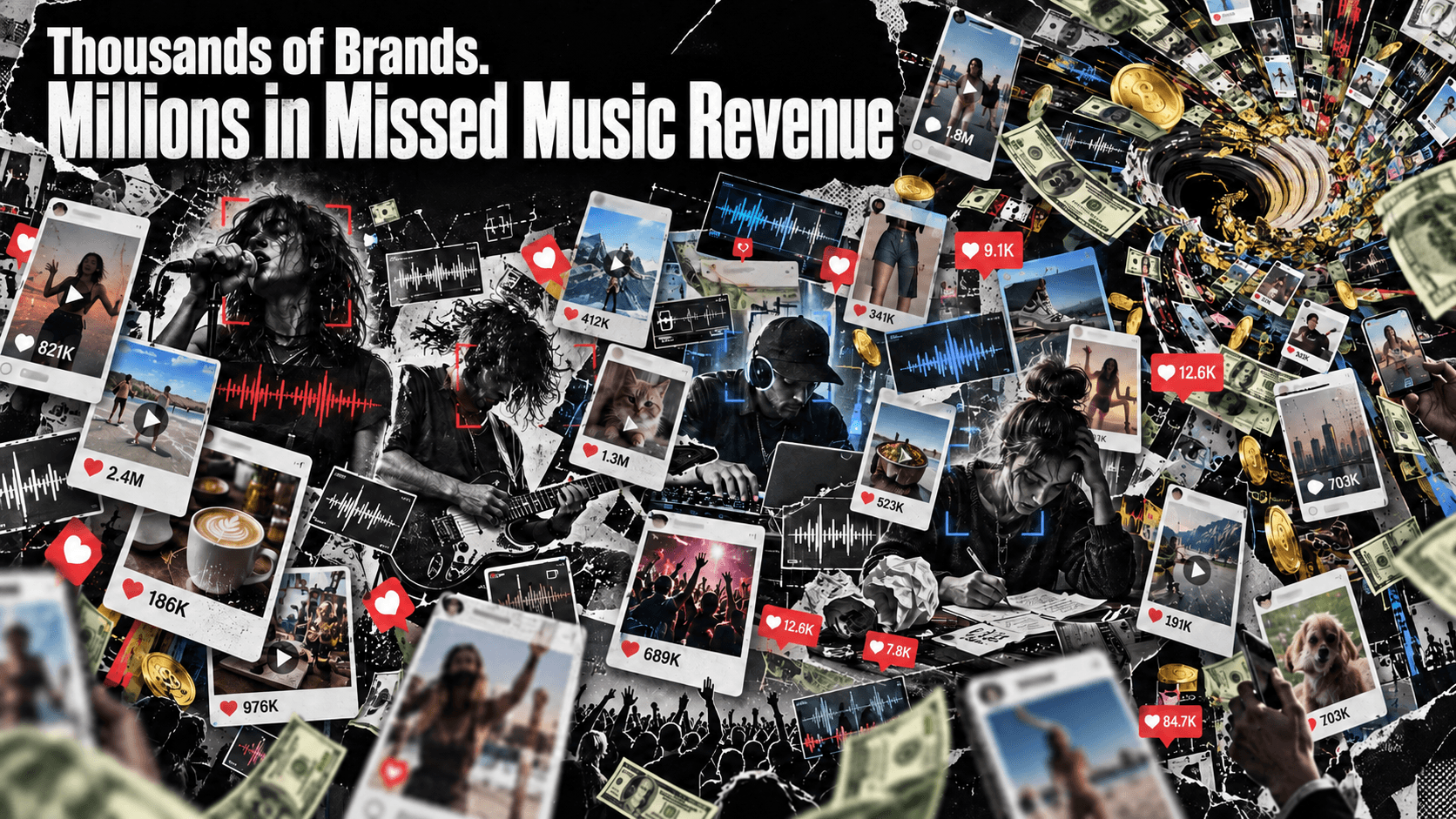
Across 714 brand accounts in 18 months, the estimated EMV captured by brands using music with no clear commercial licence is approximately $28 million, from a dataset representing less than 1% of brands regularly posting on social media.
Extrapolated to 1 million posts, the equivalent figure exceeds $1.83 billion in EMV for brands.
Artists and rights holders see none of it. These are not edge cases. The posts in our dataset had fewer than 1 million views each, below the threshold where you'd expect to see marketing budget or formal licensing arrangements. This is systematic, ongoing commercial use at the routine, day-to-day level of brand social content.
Value Generated. Nothing Paid.
The engagement figures above translate directly into commercial value.
Across 714 brand accounts in 18 months, the estimated EMV captured by brands using music with no clear commercial licence is approximately $28 million, from a dataset representing less than 1% of brands regularly posting on social media.
Extrapolated to 1 million posts, the equivalent figure exceeds $1.83 billion in EMV for brands.
Artists and rights holders see none of it. These are not edge cases. The posts in our dataset had fewer than 1 million views each, below the threshold where you'd expect to see marketing budget or formal licensing arrangements. This is systematic, ongoing commercial use at the routine, day-to-day level of brand social content.
What We Found
More than 79% of the 800 brands we analysed were using music from major label and significant independent catalogues with no clear evidence of a commercial licence. Of 800 brands, 714 were in this position.
The 4,100+ unique titles involved shows this is not a viral track problem, a handful of songs appearing repeatedly across brand content. It reflects something structural: music selection happens quickly, creatively, and almost entirely outside any licensing decision-making process.
This was not a finding of deliberate circumvention. UGC-style posts with fewer than 1M views show no clear evidence of significant marketing budget, these are routine content decisions, not campaigns with clearance budgets. But routine or not, they represent systematic, ongoing commercial use of music by brands who are capturing real commercial value from it.
What We Found
More than 79% of the 800 brands we analysed were using music from major label and significant independent catalogues with no clear evidence of a commercial licence. Of 800 brands, 714 were in this position.
The 4,100+ unique titles involved shows this is not a viral track problem, a handful of songs appearing repeatedly across brand content. It reflects something structural: music selection happens quickly, creatively, and almost entirely outside any licensing decision-making process.
This was not a finding of deliberate circumvention. UGC-style posts with fewer than 1M views show no clear evidence of significant marketing budget, these are routine content decisions, not campaigns with clearance budgets. But routine or not, they represent systematic, ongoing commercial use of music by brands who are capturing real commercial value from it.
This Was Problem Identification
This research was not designed to produce a product. It was designed to answer a question: is the gap between commercial music use and documented commercial licensing significant enough to warrant building infrastructure around it? The answer was yes.
Trakr was built on the basis of what this dataset revealed, that the music rights landscape for social and digital content lacks transparency for everyone involved: rights holders who need to see where their repertoire is being used, brands who need to understand their licensing position, and artists who have the least visibility of all into how their work is being used commercially.
Since completing this initial research and beginning to work with clients, our dataset has grown substantially. The patterns we identified in the founding research have held and deepened as we've applied the same analysis across more brands, more platforms, and more catalogue.
This Was Problem Identification
This research was not designed to produce a product. It was designed to answer a question: is the gap between commercial music use and documented commercial licensing significant enough to warrant building infrastructure around it? The answer was yes.
Trakr was built on the basis of what this dataset revealed, that the music rights landscape for social and digital content lacks transparency for everyone involved: rights holders who need to see where their repertoire is being used, brands who need to understand their licensing position, and artists who have the least visibility of all into how their work is being used commercially.
Since completing this initial research and beginning to work with clients, our dataset has grown substantially. The patterns we identified in the founding research have held and deepened as we've applied the same analysis across more brands, more platforms, and more catalogue.
Who This Affects
Rights holders: 714 out of 800 brands in a sub-1% sample were using music with no clear commercial licence, generating an estimated $28M in EMV. Labels, publishers, and the artists they represent are operating with limited visibility into where their repertoire is going and what commercial value it is generating for others. The opportunity is not enforcement for its own sake; it's having an accurate, scalable picture of what's happening.
Brands: The pattern our data reveals is structural, not the result of deliberate circumvention. Music decisions happen quickly in content workflows, platforms make them easy, and licensing considerations are rarely built in at the point of creation. Understanding what's in your content is the starting point for any informed decision about your licensing position.
Artists: The 1.14 billion views in our dataset belong to content that used music from 4,100+ unique recordings. In most cases, the artists who made that music have no visibility into which brands used their tracks, at what scale, or what commercial value that use generated. That is a visibility gap that affects catalogue decisions, licensing conversations, and the basic question of what your music is actually worth commercially.
Who This Affects
Rights holders: 714 out of 800 brands in a sub-1% sample were using music with no clear commercial licence, generating an estimated $28M in EMV. Labels, publishers, and the artists they represent are operating with limited visibility into where their repertoire is going and what commercial value it is generating for others. The opportunity is not enforcement for its own sake; it's having an accurate, scalable picture of what's happening.
Brands: The pattern our data reveals is structural, not the result of deliberate circumvention. Music decisions happen quickly in content workflows, platforms make them easy, and licensing considerations are rarely built in at the point of creation. Understanding what's in your content is the starting point for any informed decision about your licensing position.
Artists: The 1.14 billion views in our dataset belong to content that used music from 4,100+ unique recordings. In most cases, the artists who made that music have no visibility into which brands used their tracks, at what scale, or what commercial value that use generated. That is a visibility gap that affects catalogue decisions, licensing conversations, and the basic question of what your music is actually worth commercially.
Methodology
We selected 800 brands with active TikTok presences, spanning sectors including consumer goods, fashion, food and beverage, financial services, entertainment, and retail. For each of the 200,000+ posts, every musical recording was identified using dual ACR fingerprinting and native platform metadata, cross-referenced against multiple sources to identify title, artist, writers, labels, and publishers.
The system handles the realities of social audio: speed and pitch changes, remixes, mashups, samples, covers, and background music. We assessed the licensing context for each use: direct commercial licence, TikTok Commercial Music Library listing, or no clear licensing evidence. Posts were classified as having "no clear licensing evidence" where the music was from a major label or significant independent catalogue and we could find no evidence of a commercial licence, sync agreement, or Commercial Music Library listing covering the use.
This is not a finding of infringement. Establishing infringement requires legal process and detailed rights holder data. What this research measures is the gap between the scale of commercial music use and the scale of documented commercial licensing, and the commercial value being captured in that gap.
The research covers content published between July 2024 and January 2026.
Methodology
We selected 800 brands with active TikTok presences, spanning sectors including consumer goods, fashion, food and beverage, financial services, entertainment, and retail. For each of the 200,000+ posts, every musical recording was identified using dual ACR fingerprinting and native platform metadata, cross-referenced against multiple sources to identify title, artist, writers, labels, and publishers.
The system handles the realities of social audio: speed and pitch changes, remixes, mashups, samples, covers, and background music. We assessed the licensing context for each use: direct commercial licence, TikTok Commercial Music Library listing, or no clear licensing evidence. Posts were classified as having "no clear licensing evidence" where the music was from a major label or significant independent catalogue and we could find no evidence of a commercial licence, sync agreement, or Commercial Music Library listing covering the use.
This is not a finding of infringement. Establishing infringement requires legal process and detailed rights holder data. What this research measures is the gap between the scale of commercial music use and the scale of documented commercial licensing, and the commercial value being captured in that gap.
The research covers content published between July 2024 and January 2026.
Access the Full Data
The complete dataset, including brand-level breakdowns, catalogue analysis, and sector patterns is available to qualified rights holders, labels, publishers, and brands. Our current working dataset, built through active client work since this founding research, is substantially larger.
Request the full report → contact@trakr.music
Access the Full Data
The complete dataset, including brand-level breakdowns, catalogue analysis, and sector patterns is available to qualified rights holders, labels, publishers, and brands. Our current working dataset, built through active client work since this founding research, is substantially larger.
Request the full report → contact@trakr.music
Further Reading
1.14 Billion Views: What We Found About Music Use in Brand Content
the full analysis and what the findings mean for each party involved.
What Social Media Isn't Telling Artists About Their Music
the artist perspective on the commercial visibility gap.
Why Catalog Visibility Matters
how rights holders are approaching the broader monitoring challenge
Further Reading
1.14 Billion Views: What We Found About Music Use in Brand Content
the full analysis and what the findings mean for each party involved.
What Social Media Isn't Telling Artists About Their Music
the artist perspective on the commercial visibility gap.
Why Catalog Visibility Matters
how rights holders are approaching the broader monitoring challenge